
Menu
Porcelain · Technique
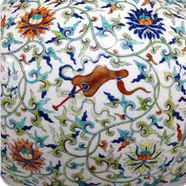
Underglaze blue outlines filled with overglaze enamels in a second firing. Defined by the precision of registration between the two layers.
Technique
Doucai — literally "contrasting colours" — begins with an underglaze cobalt blue outline painted onto the unfired body, which is then glazed and fired once at high temperature. The outlined piece is fired a second time at a lower temperature, during which overglaze enamels are added inside the blue outlines. The technique depends on precise registration between the two layers: the overglaze colour has to land inside a boundary that was fixed during the first firing and cannot be adjusted afterward.
Doucai reached its defining expression during the Chenghua reign (1465–1487), on porcelain associated with the imperial court. The technique's demand for accuracy across two separate firings, weeks or months apart, made it a marker of workshop discipline rather than a routine production method.
Quality is judged by how closely the overglaze fill sits within the underglaze outline — visible gaps or overruns indicate a lower level of control. Because the technique involves two firings, the palette tends toward a small number of clear, separated colours rather than dense polychrome coverage.
Contemporary objects connected to this tradition
Continue exploring
Decorative system
Underglaze Decoration