
Menu
Porcelain · Technique
Overglaze enamels softened with an opaque white, allowing shaded, graduated colour. Developed in the Qing dynasty.
Technique
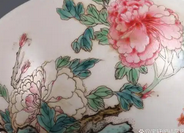
Fencai introduces an arsenic-based opaque white pigment mixed into overglaze enamels, which scatters light and allows a single base colour to be diluted into a graduated range of tones — a technical capability underglaze and earlier overglaze systems did not have. Colours are painted over the fired glaze and fixed with a second, lower-temperature firing.
The technique developed during the Qing dynasty, building on earlier overglaze enamel work such as wucai but extending the palette's range through the opaque white medium. Colloidal gold suspended in the pigment produces the characteristic rose-pink tones that give the system its Western name, famille rose.
The defining visual trait is tonal gradation within a single colour field — shading from a saturated edge to a pale centre in one continuous brushstroke — rather than the flat, separated colour blocks typical of earlier enamel systems.
Contemporary objects connected to this tradition
Continue exploring
Decorative system
Overglaze Decoration