
Menu
Porcelain · Technique
Multiple overglaze enamels in flat, bounded colour fields, fixed in a second low firing. Late Ming to early Qing.
Technique
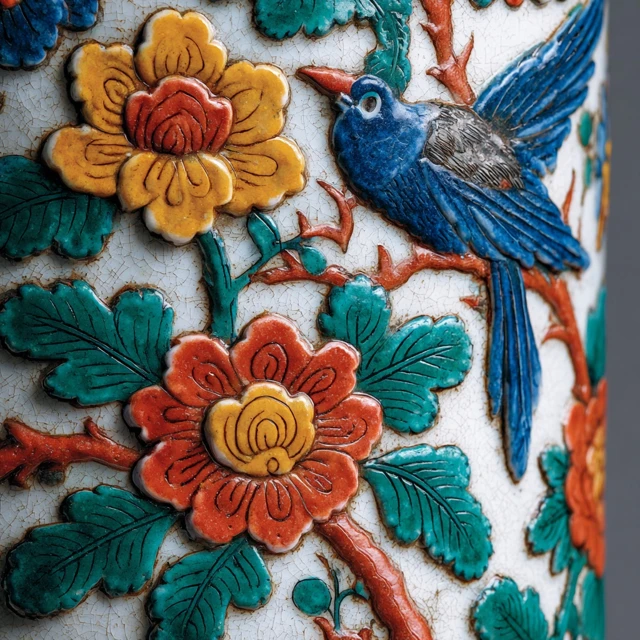
Wucai — "five colours" — layers multiple overglaze enamels onto an already-glazed and fired piece, then fixes the enamels with a second, lower-temperature firing. Each colour is typically applied as a flat, separated field rather than blended, giving the system its characteristic graphic quality.
Wucai developed through the late Ming dynasty and continued into the early Qing, predating the tonal blending techniques that fencai would later introduce. Where doucai relies on a fixed underglaze outline, wucai's decoration is drawn more freely across the surface in the second firing.
Colours read as distinct, bounded fields — red, green, yellow, and aubergine over a blue or white ground are common — rather than as shaded or blended tones, giving wucai pieces a bold, direct visual character.
Many wucai pieces include underglaze cobalt blue (青花五彩). Those objects combine underglaze and overglaze layers and therefore also belong to Combined Decoration.
Contemporary objects connected to this tradition
Continue exploring
Decorative system
Overglaze Decoration