
Menu
牡丹纹
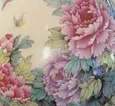
The peony is China's most prominent floral emblem of wealth, rank, and honour, and the dominant floral motif in Qing overglaze enamel production.
Motif Study
Known historically as the 'king of flowers,' the peony carries associations with wealth, high social rank, and honour rather than the more spiritual associations of the lotus. Its large, layered petals and full bloom made it a natural subject for the tonal shading techniques introduced in Qing overglaze enamel systems.
Peony motifs appear across blue-and-white and polychrome production alike, but reach their fullest expression in Qing fencai (famille rose) ware, where the arsenic-based opaque white pigment allowed painters to render the gradual colour shifts across a peony's petals with a naturalism earlier overglaze systems could not achieve. It is often paired with the phoenix — rank alongside prosperity — or shown alongside other flowers of the four seasons.
Peonies are typically shown in full frontal or three-quarter bloom, with layered petals rendered through graduated shading rather than flat colour fields, distinguishing fencai peony work from the flatter, more graphic floral painting of earlier wucai and doucai systems.
Further Reading
Contemporary objects connected to this motif
Continue exploring