Menu
莲纹
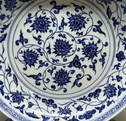
The lotus is a Buddhist symbol of purity, rising unstained from muddy water, and one of the most consistently used floral motifs across the full span of Jingdezhen production.
Motif Study
Because the lotus flower emerges clean from murky water, it became established in Buddhist iconography as an emblem of purity and spiritual detachment, and this meaning carried directly into Chinese decorative arts. The motif's durability across a thousand years of production — from Song celadon through Qing enamels — makes it one of the most continuous visual threads in the Jingdezhen record.
In Confucian literati culture the lotus is also regarded as the gentleman among flowers. This association was given enduring expression by the Song scholar Zhou Dunyi (周敦颐) in his short essay On the Love of the Lotus (爱莲说), which praises the flower for rising from the mud unstained.
Lotus scroll borders appear on Yuan-dynasty blue-and-white ware as a standard framing device, and the motif remains common through the Ming and Qing in three principal treatments: a continuous scrolling border, a central medallion, and a full pond scene with lotus, waterfowl, and reeds. The pond-scene version, sometimes called 'lotus pond' decoration, was especially prominent in Yuan and early Ming export wares bound for Islamic markets, where large-scale dishes carried the motif as a central design.
Lotus scroll work follows a repeating rhythmic structure — flower, leaf, tendril — that made it well suited to border bands of varying width, from narrow rim decoration to full-body wraparound registers. This structural flexibility is part of why it persisted across so many forms and periods without falling out of production.
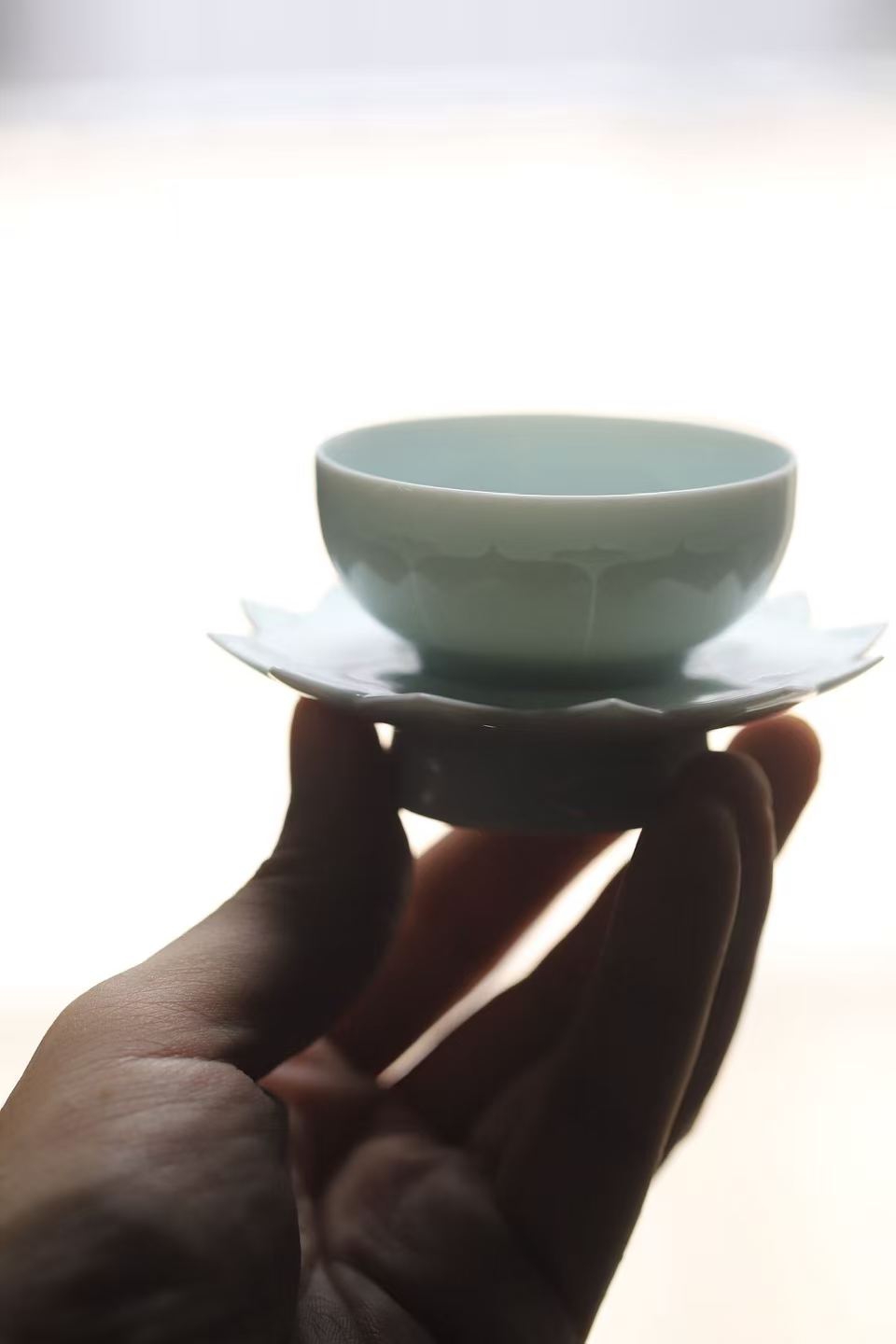
This page brings together three ways the lotus appears in porcelain: as applied decoration, such as painted scrolls and petal borders; as the shape of the vessel itself, as in a lotus-petal cup stand; and as a carrier of cultural meaning. Where the lotus shapes the vessel, Blue Fir also records it as the Lotus-petal Form feature. Each object below notes which relation applies.
Further Reading
Contemporary objects connected to this motif
Continue exploring
Form
Lotus-petal FormForm
Cup StandMaterial
Qingbai / Yingqing GlazePeriod
Song Dynasty